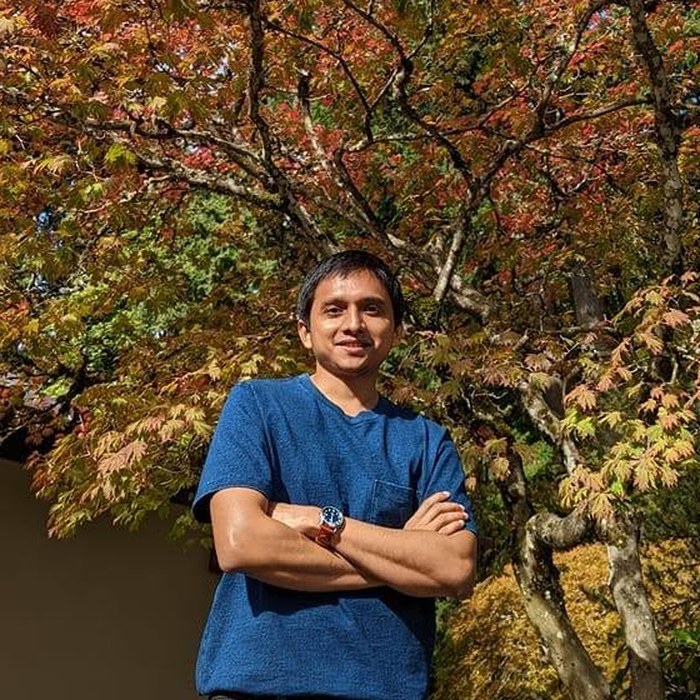
Md Montaser Hamid

Ph.D. Candidate, Computer Science · Oregon State University

Corvallis, OR, USA · montaserhamid.com · Advised by Margaret Burnett (Distinguished Professor) and co-advised by Anita Sarma (Professor), Oregon State University.

About

Md Montaser Hamid

I work at the intersection of human–AI interaction, explainable AI (XAI), and user-centric design. My dissertation develops "Ed for AI", a design framework that treats AI explanations as a teaching–learning process: instead of only applying AI to improve education, I bring educational theories into the design of XAI systems so that explanations help users learn how AI works, not just receive information.

My broader research demonstrates that designing AI explanations for users whose problem-solving styles are often underserved can improve mental models of AI for everyone, showing a measurable "curb-cut" effect. Methodologically, I use mixed methods end to end, from theory-grounded hypothesis generation and interactive prototyping to user studies, controlled lab experiments, and qualitative and quantitative data analysis.

I am on the job market — graduating in March 2027 and seeking tenure-track faculty, postdoc, and research/applied scientist positions.

  • Human–AI Interaction
  • Explainable AI
  • User-Centric Design
  • AI & Education

News

2026
Our article "Inclusive Design of AI's Explanations: Just for Those Previously Left Out, or for Everyone?" is published in ACM Transactions on Interactive Intelligent Systems (TiiS). Overview →
2026
Our paper on "Over-the-Hood" AI inclusivity bugs and GenderMag-for-AI appears at ACM IUI 2026. Overview →
2025
"Intersectional HCI on a Budget: An Analytical Approach Powered by Types" is published in the International Journal of Human–Computer Interaction. Overview →
2025
Our workshop paper “Loss in Value”: What it Revealed about WHO an Explanation Serves Well and WHEN is presented at the ACM IUI Workshops 2025. Overview →

Selected Publications

See all publications →

Education

Expected Mar 2027
Ph.D. in Computer Science
Oregon State University, Corvallis, OR
Dissertation: Educational Theories' (Potential) Impacts on Explainable AI. Advisor: Margaret Burnett · Co-advisor: Anita Sarma. Committee: Glencora Borradaile, Karthika Mohan, Jennifer Parham-Mocello.
Dec 2023
M.S. (thesis) in Computer Science
Oregon State University, Corvallis, OR
Thesis: Improving User Mental Models of XAI Systems with Inclusive Design Approaches.
2018
B.S. in Computer Science & Engineering
Shahjalal University of Science and Technology, Bangladesh

Research Experience

Jun 2021 – Present
Graduate Research Assistant, Oregon State University
AgAID Institute (NSF/USDA) · Advisor: Margaret Burnett
  • Developed human-centered AI technologies for farmers and agricultural stakeholders in the US, as part of the AgAID Institute's mission to improve AI-driven decision support and workforce assistance in agriculture.
  • Designed and led a 69-participant between-subject controlled experiment demonstrating that users' problem-solving diversity-driven redesign of an XAI prototype significantly improved users' mental models of AI and engagement with explanations, with benefits extending to all users ("curb-cut" effect) — first-author publication in ACM TiiS.
  • Co-developed GenderMag-for-AI, a variation of the GenderMag inclusivity evaluation method for user-facing AI products; in a field study, 3 AI product teams used it to identify 83 AI inclusivity bugs and fixes covering 47 bugs (ACM IUI 2026).
  • Co-developed a type-powered analytical approach to intersectional HCI evaluation that reduces the cost of multi-population empirical studies (IJHCI 2025), and a validated survey method for actionable diversity measurement in technology (Apress 2024).
2021 – 2022
Graduate Research Assistant, Oregon State University
Data Interaction and Visualization Lab, DARPA Explainable AI (XAI) program · Advisor: Minsuk Kahng
  • Co-developed an interactive treemap-based visualization tool for exploring large-scale image datasets and analyzing/debugging errors of object detection models (IEEE TVCG / VIS 2022).
Feb 2018 – Apr 2018
Research Assistant, USAID Agricultural Extension Project
Sylhet, Bangladesh
  • Evaluated the performance of ICT interventions empowering agricultural extension personnel (SAAOs and UAOs), the major stakeholders in Bangladesh's agricultural extension system.

Teaching

Spring 2021
Graduate Teaching Assistant, Oregon State University — CS 325: Analysis of Algorithms
Graded coding assignments and exams; held weekly office hours supporting students on algorithm design and analysis.
2018 – 2021
Lecturer, Ranada Prasad Shaha University
Instructor of record: Object-Oriented Programming · Software Engineering & Information System Design · Theory of Computation · Basic Graph Theory.

Other Professional Experience

2017 – 2018
Smartphone Application Developer
BRAC Early Childhood Development Program, Bangladesh
  • Designed and developed a smartphone application for early childhood development in developing countries, deployed by BRAC, the world's largest NGO.

Honors & Awards

2017
Champion, BRACAthon II — inter-university hackathon organized by BRAC
2017
Champion, IT Business Idea Competition, Islamic University of Technology ICT Fest
2017
Runner-up, Daffodil Inter-University App Contest
2017
Runner-up, Shahjalal University of Science and Technology CSE FEST Hackathon

Research Skills & Methods

Empirical methods
Controlled lab experiments, hypothesis testing, mixed-methods research, semi-structured interviews, surveys, usability studies, A/B testing, thematic analysis, qualitative coding
Analytical methods
GenderMag & GenderMag-for-AI, cognitive walkthrough, heuristic evaluation, intersectional analysis
Prototyping
Low/high-fidelity prototyping, interactive prototyping, agentic-AI (LLM-based) prototyping, Figma
Programming
Python, R, JavaScript, Svelte, Java, C#, C, SQL, MATLAB, HTML, CSS, LaTeX